
Adapting cities to hotter summers means making decisions street by street. At SCCON 2026, meteoblue will show how urban climate data helps municipalities decide where to plant trees, add shade and create more comfortable public spaces.
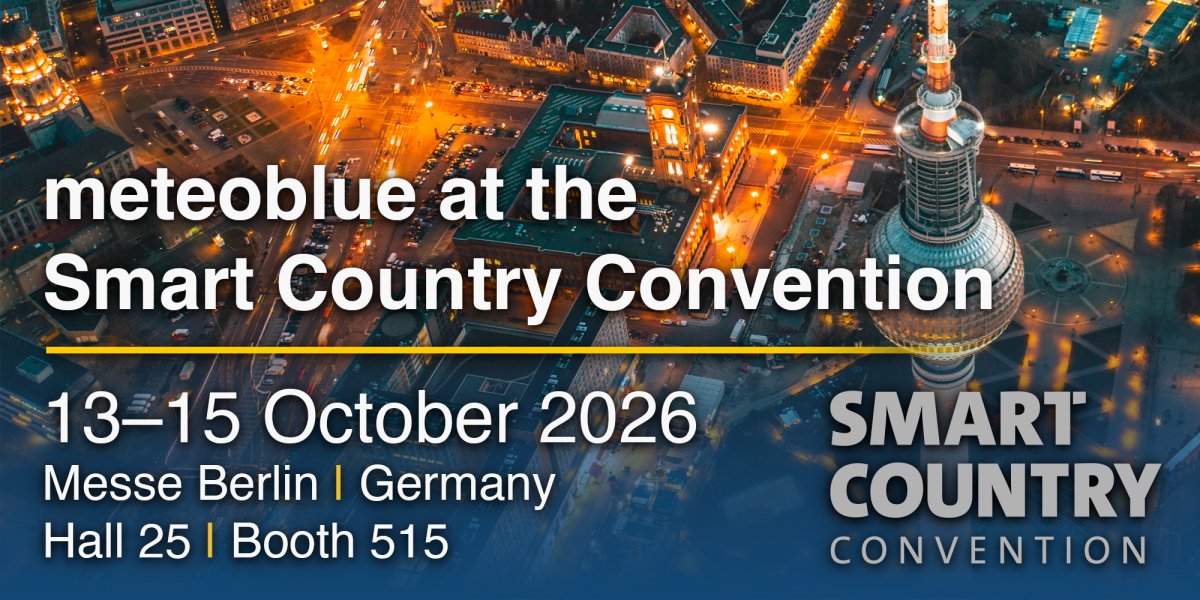
The Smart Country Convention takes place at Messe Berlin from 13 to 15 October 2026. Nico Bader and Nicolas Zurfluh will represent meteoblue in Hall 25, Booth 515, at a shared stand with Orbisens and Urban Lighting Innovations.
Together, the three companies will present the full process from measurement to climate adaptation. Orbisens provides the hardware for measuring urban climate, while Urban Lighting Innovations handles installation, maintenance and infrastructure management. meteoblue contributes the usual – weather modelling, data visualisation and analytics that turn these measurements into a detailed picture of local conditions.
Europe is warming faster than any other continent, and recent heatwaves have underlined the need for places where people can find relief. For a municipality, the challenge is knowing which streets and neighbourhoods need attention first, and which measures are likely to help.
Did you know that the air temperature gap between a city and its rural surroundings can be greatest after sunset, especially on clear, calm nights? Roads and buildings slowly release heat stored during the day. Concrete, unfortunately, does not clock off at six.
The urban climate solutions from meteoblue combine local measurements with high-resolution modelling to map temperature differences at 10 m resolution and locate heat hotspots. This can inform tree planting, shading and the redesign of paved spaces – for example around schools, care facilities and busy pedestrian routes. Trees provide shade and cool their surroundings as water evaporates from their leaves. Local data helps planners identify where that cooling could be most useful.
For residents, better-informed planning can help create more comfortable places to walk, wait, play and spend time outdoors. Continued monitoring also helps cities assess how local conditions change after adaptation measures are introduced, providing evidence to guide further investment.
Visit us in Hall 25, Booth 515 to discuss the challenges in your municipality and explore how a coordinated approach to sensors, infrastructure and climate analysis could support your next steps!


