
Weather forecasts are often presented as specific values: 24°C in the afternoon, 15 km/h winds, rain beginning at 17:00. This can make the atmosphere appear more predictable than it really is, because every forecast contains some degree of uncertainty.
Meteorologists observe the atmosphere using weather stations, satellites, radar, radiosondes and many other systems, but observations can never describe every part of it perfectly. Weather models are also necessarily simplified representations of an extraordinarily complex system.
Small uncertainties today can lead to much larger differences several days later. This is one of the fundamental characteristics of atmospheric predictability and the reason why modern forecasting increasingly looks beyond a single possible outcome.
Why weather forecasts are uncertain
A numerical weather prediction model begins with an estimate of the current atmosphere and calculates how it will evolve according to physical equations. Measurements are unevenly distributed around the world, while processes such as clouds, turbulence and convection cannot always be represented in complete detail.
There is also the chaotic nature of the atmosphere itself. Small differences in temperature, pressure, humidity or wind at the beginning of a simulation may initially appear insignificant, but can grow with time and eventually produce noticeably different weather patterns. This sensitivity to initial conditions is one of the reasons ensembles are used to represent forecast uncertainty.
One way of imagining this is to picture several leaves dropped almost next to each other into a fast-moving river. Their paths may initially be similar, but farther downstream, small differences in the currents can send them in different directions. Weather forecasts behave in a similar way.
One forecast or many possible futures?
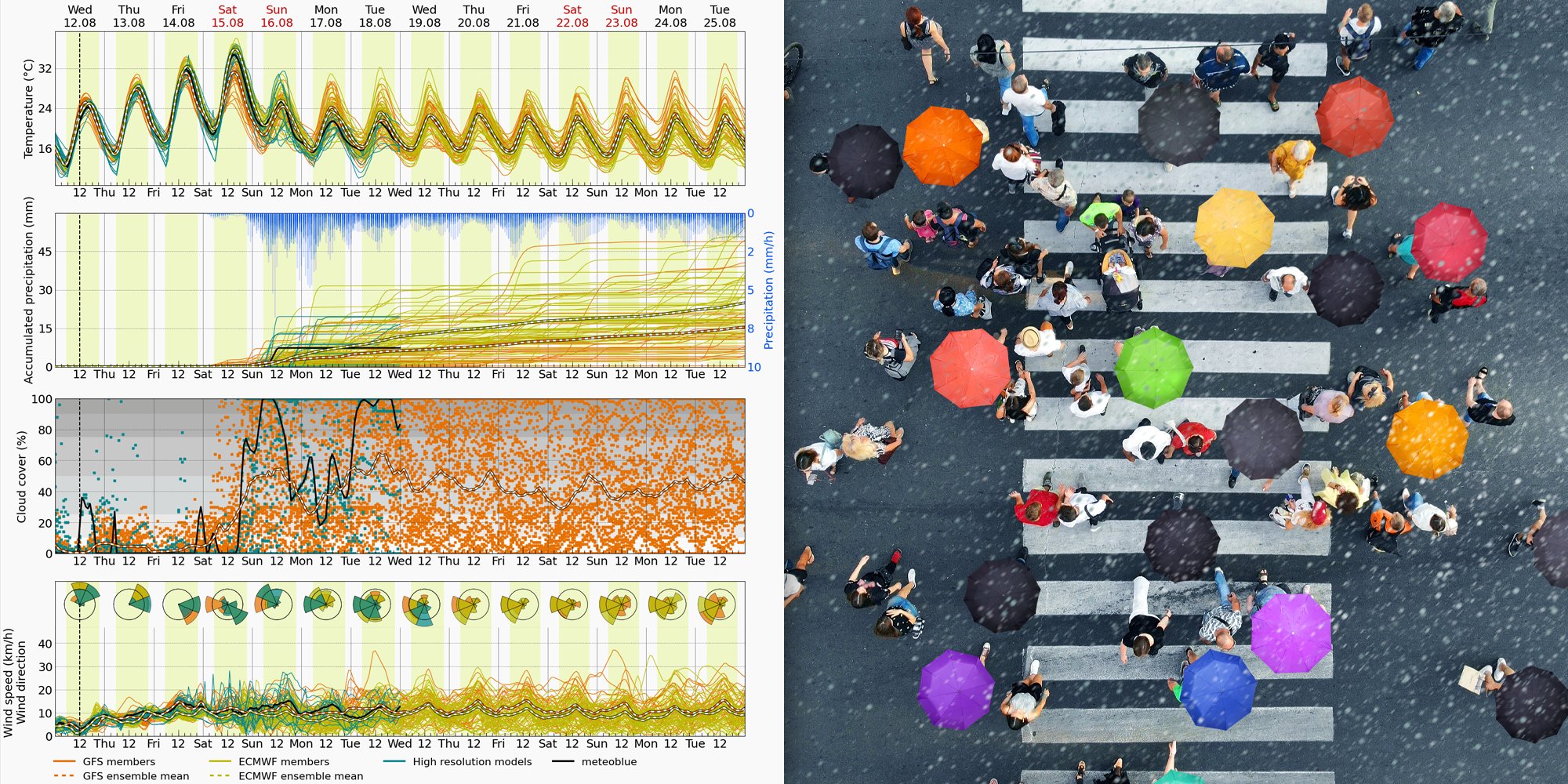
A traditional deterministic forecast calculates one evolution of the atmosphere from one set of starting conditions. An ensemble forecast, by contrast, calculates the forecast multiple times using slightly different initial conditions or model configurations. Each simulation represents one plausible evolution of the atmosphere.
If most ensemble members remain close together, confidence is relatively high. If they diverge, uncertainty increases. For example, if almost all simulations predict temperatures between 24°C and 26°C, there is strong agreement. If the simulations range from 17°C to 29°C, however, there is much more uncertainty about the expected temperature – something a single average value would not reveal.
The spread between forecasts is therefore useful weather information in its own right.
What does a 30% chance of rain actually mean?
Precipitation probability is likely the most familiar example of probabilistic weather information, but it is also one of the easiest to misinterpret. Research has found several common interpretations of a 30% probability, including that rain will occur during 30% of the forecast period or across 30% of the forecast area.
A 30% chance of rain does not automatically mean rain for 30% of the day, rain across 30% of the area or rainfall at 30% intensity. The exact definition depends on the forecast product, location, precipitation threshold and time interval.
For a probability referring to your location during a defined period, a 30% chance of rain means that rain is less likely than dry weather, but remains a realistic possibility. Turned around, it also means a 70% chance of remaining dry.
Over many comparable situations, a well-calibrated 30% forecast should see the event occur roughly three times out of ten.
Probability does not tell you intensity
One important distinction is the difference between likelihood and severity. A low probability does not necessarily mean weak weather.
A forecast with a 30% chance of thunderstorms may mean that most plausible scenarios remain dry while a smaller proportion develop a storm. If a storm does develop, however, it could still be severe. Research into probability communication specifically identifies this as a potential source of misunderstanding.
The same applies to heavy rain, strong winds and other high-impact weather. Probability therefore needs to be considered together with potential consequences. A 10% chance of light rain might be easy to ignore, while a 10% chance of destructive wind may deserve considerably more attention.
If it rains on a 10% forecast, was the forecast wrong?
Suppose tomorrow's forecast gives your location a 10% chance of rain, and then it rains. Was the forecast incorrect?
Not necessarily. Probability forecasts cannot be properly judged from a single event. If rain occurs on roughly 10 out of 100 comparable occasions when a 10% probability was forecast, the system is behaving as expected. Meteorologists refer to this property as reliability or calibration.
This can feel counterintuitive because we naturally want to classify forecasts as right or wrong. Probabilities contain more information: an unlikely event occurring does not automatically mean its probability was incorrect.
Why forecast probabilities change
A forecast may show a 70% chance of rain several days ahead, fall to 40% with the next update and then rise again. This does not necessarily indicate poor forecasting; it reflects new information entering the system.
Weather observations are constantly being collected, and each new model cycle starts with an updated description of the atmosphere. As an event approaches, the position of a front, low-pressure system or thunderstorm area may become clearer, while ensemble members may converge towards one scenario or continue to disagree.
Probabilities therefore represent the best estimate based on the information available at that particular time.
Why uncertainty grows with forecast range
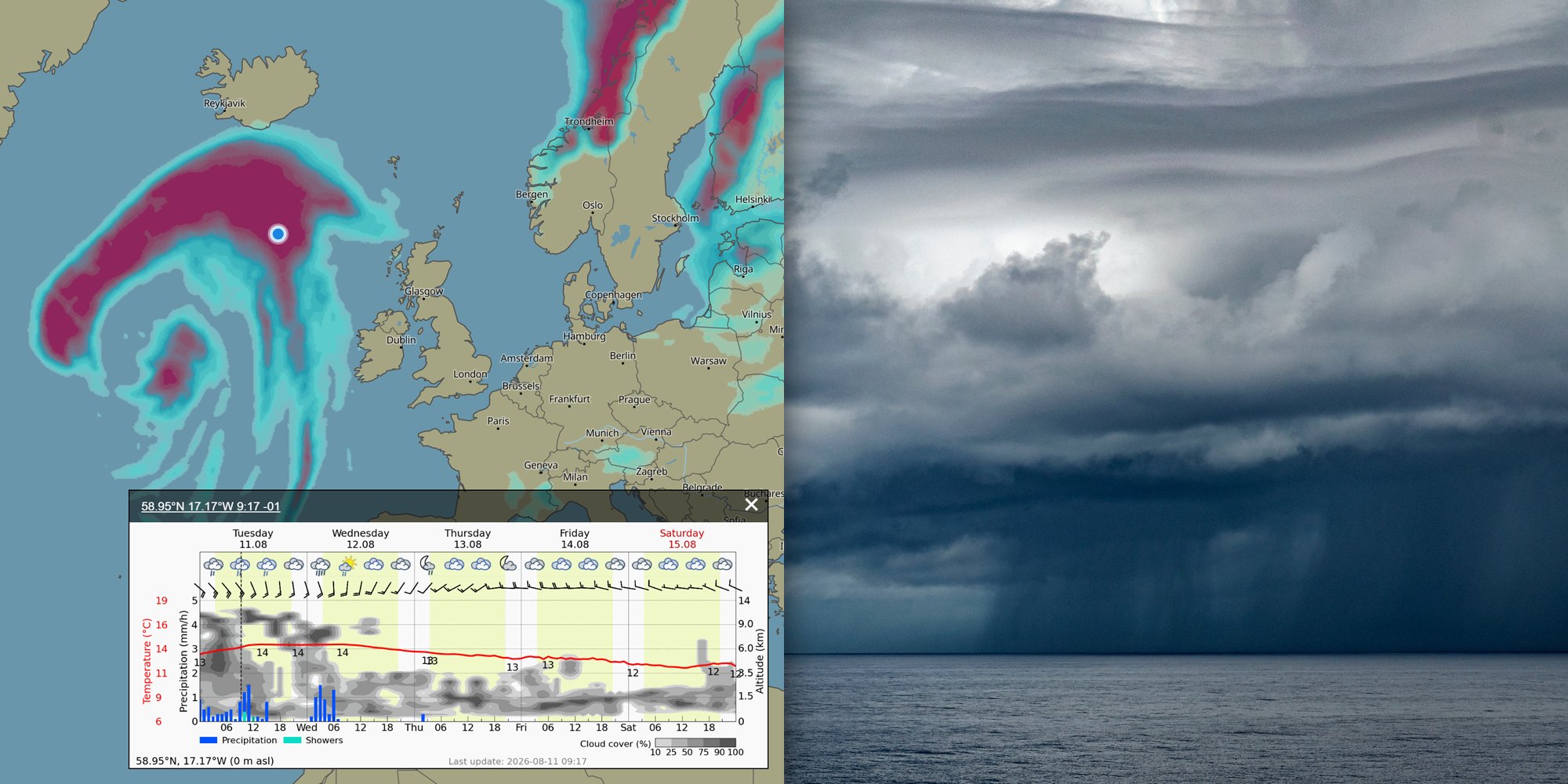
Forecast confidence also depends strongly on how far ahead we are looking. Tomorrow's weather has only a short time to diverge from today's observed atmospheric state. Ten days ahead, small uncertainties have had much longer to develop.
At longer forecast horizons, it is therefore often more useful to consider a range of plausible conditions rather than focus on one exact value. A single model may suddenly predict a storm while most other scenarios do not, and ensemble information helps put that individual forecast into context.
The same probability can lead to different decisions
Weather probabilities become especially useful when connected to decisions. Someone walking five minutes to a café may ignore a 30% chance of rain, while someone organising an outdoor wedding may prepare a covered area. A construction manager might postpone weather-sensitive work if rainfall would create significant safety or financial consequences.
The meteorological information is the same, but the consequences are different. This principle also applies to energy, aviation, logistics and agriculture, where decisions may depend on the probability of crossing specific weather thresholds. How people respond to a weather probability depends largely on the potential consequences of the event.
Probability does not decide what action should be taken, but it provides information for deciding what level of risk is acceptable in a particular situation.
Understanding forecast confidence with meteoblue
meteoblue provides several ways to understand forecast confidence beyond a single forecast value. The MultiModel Ensemble compares forecasts from several global and regional weather models, allowing users to see how closely different forecasting systems agree.
If the models forecast similar temperatures, precipitation or wind conditions, there is stronger agreement about the general development. Large differences reveal situations where the atmospheric evolution is less certain. A traditional ensemble and a MultiModel comparison are not identical – the former generally consists of multiple members within one forecasting system, while the latter compares different modelling systems – but both provide valuable information about possible outcomes.
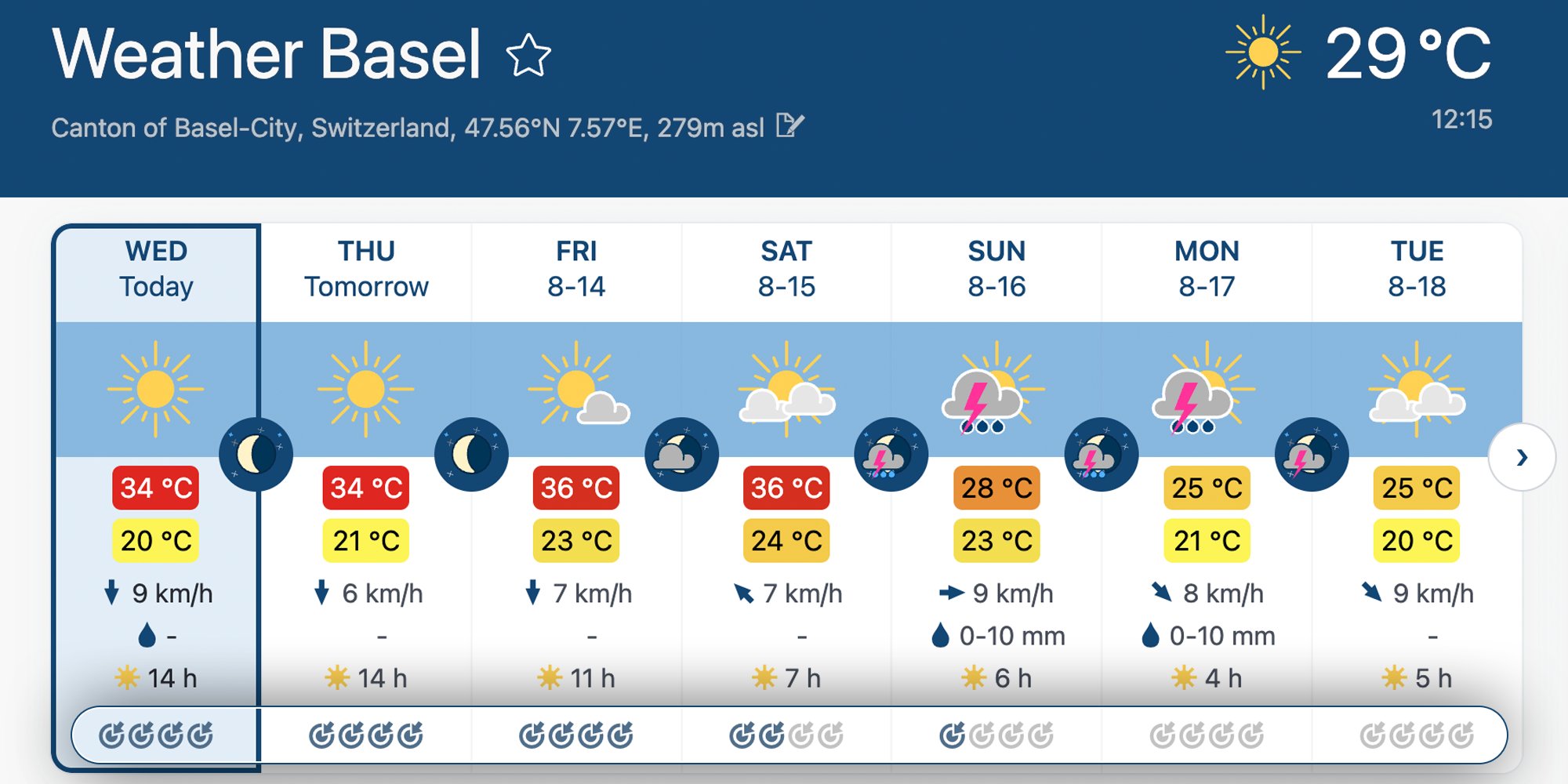
meteoblue also communicates predictability within its forecasts. A prediction of 24°C with high predictability should be interpreted differently from the same 24°C with low predictability, where alternative scenarios differ more strongly.
For professional applications, probabilistic weather information is also available through meteoblue APIs, including risk indicators and ensemble-based products for conditions such as heat, fog, precipitation and thunderstorms.
The purpose is not to make forecasts more complicated, but to make the uncertainty already present in them visible and useful.
Learning to read forecasts differently
Modern forecasting looks at several possible weather outcomes, not just one prediction. Better observations, higher-resolution models, artificial intelligence and greater computing power continue to improve prediction, while the chaotic nature of the atmosphere means that predictability generally decreases with increasing lead time.
Probability adds important context to the forecast. It tells us not only whether rain is expected, but how likely it is; not only the expected temperature, but how much the possible outcomes may vary. It also helps put less likely scenarios into perspective, especially when their potential consequences are significant.
Looking at probabilities alongside forecast values gives a clearer picture of what may happen and how much confidence we can place in a particular scenario. This makes it easier to distinguish between the most likely outcome and possibilities that are less likely but still worth considering.
Interested in discussing this topic further? Join the conversations in the meteoblue Community Forum, where you can exchange ideas, ask questions and discuss weather and forecasting with other weather enthusiasts.