
Understanding how these different approaches work together provides deeper insight into how modern forecasts are produced and why they continue to improve.
Global and Regional Weather Models
Numerical weather prediction models are generally divided into two main categories: global models and regional models. Both simulate the same atmospheric physics but differ in geographical coverage, spatial resolution and purpose.
Global models simulate the atmosphere across the entire planet. They provide a continuous representation of atmospheric conditions from pole to pole and are essential for understanding large-scale circulation patterns such as jet streams, planetary waves and major pressure systems. Because they cover the entire Earth, global models must balance spatial resolution with computational cost. As a result, their grid spacing is typically larger than that of regional models.
Several major global models are used operationally by meteorological agencies around the world. These include the Global Forecast System (GFS) operated by the United States National Centers for Environmental Prediction, the Integrated Forecasting System (IFS) operated by the European Centre for Medium-Range Weather Forecasts, the ICON model developed by the German Weather Service and the German Aerospace Center, the Global Environmental Multiscale Model (GEM) operated by Environment and Climate Change Canada, ARPEGE developed by Météo-France and the Unified Model (UM) of the UK Met Office. These models typically provide forecasts extending from several days to approximately two weeks ahead and form the backbone of global weather prediction.
Regional models, sometimes referred to as limited-area models, focus on a specific geographical region such as Europe, North America or East Asia. Because they simulate a smaller domain, they can operate at significantly higher spatial resolution. This allows them to represent smaller-scale atmospheric features more accurately, including complex terrain, coastal effects, local wind systems and convective storms. Examples of regional models include COSMO-D2 used by the German Weather Service for high-resolution forecasts over Germany, the ICON-EU regional configuration of the ICON model and the widely used Weather Research and Forecasting Model (WRF).
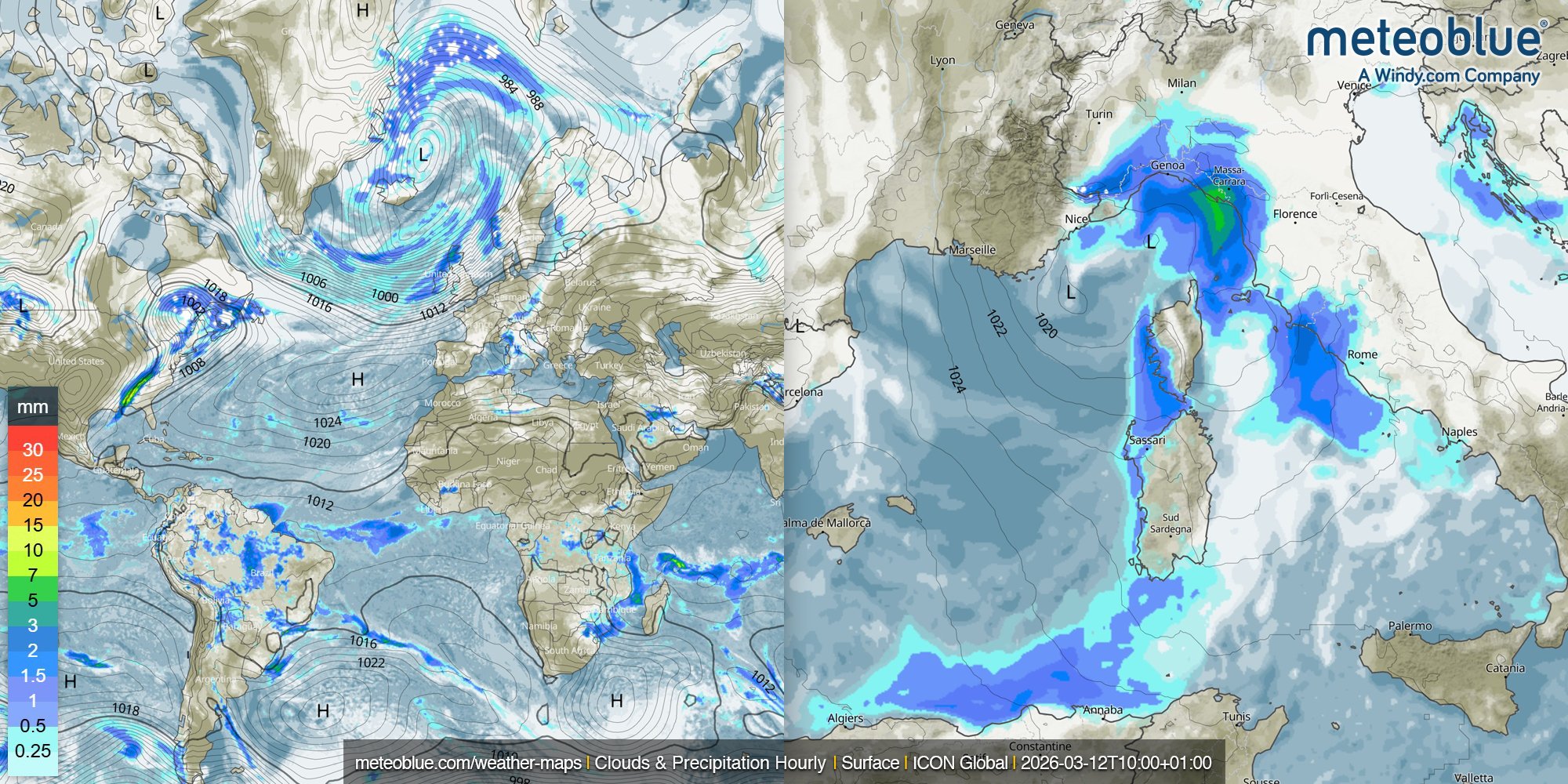
Regional models depend on global models for their large-scale atmospheric context. Global simulations provide the boundary conditions that drive the regional forecasts. In practice, forecasting centres often run both global and regional models simultaneously, combining the strengths of each to produce forecasts that are both physically consistent at the planetary scale and highly detailed at the local scale.
Ensemble Forecasting: Embracing Atmospheric Uncertainty
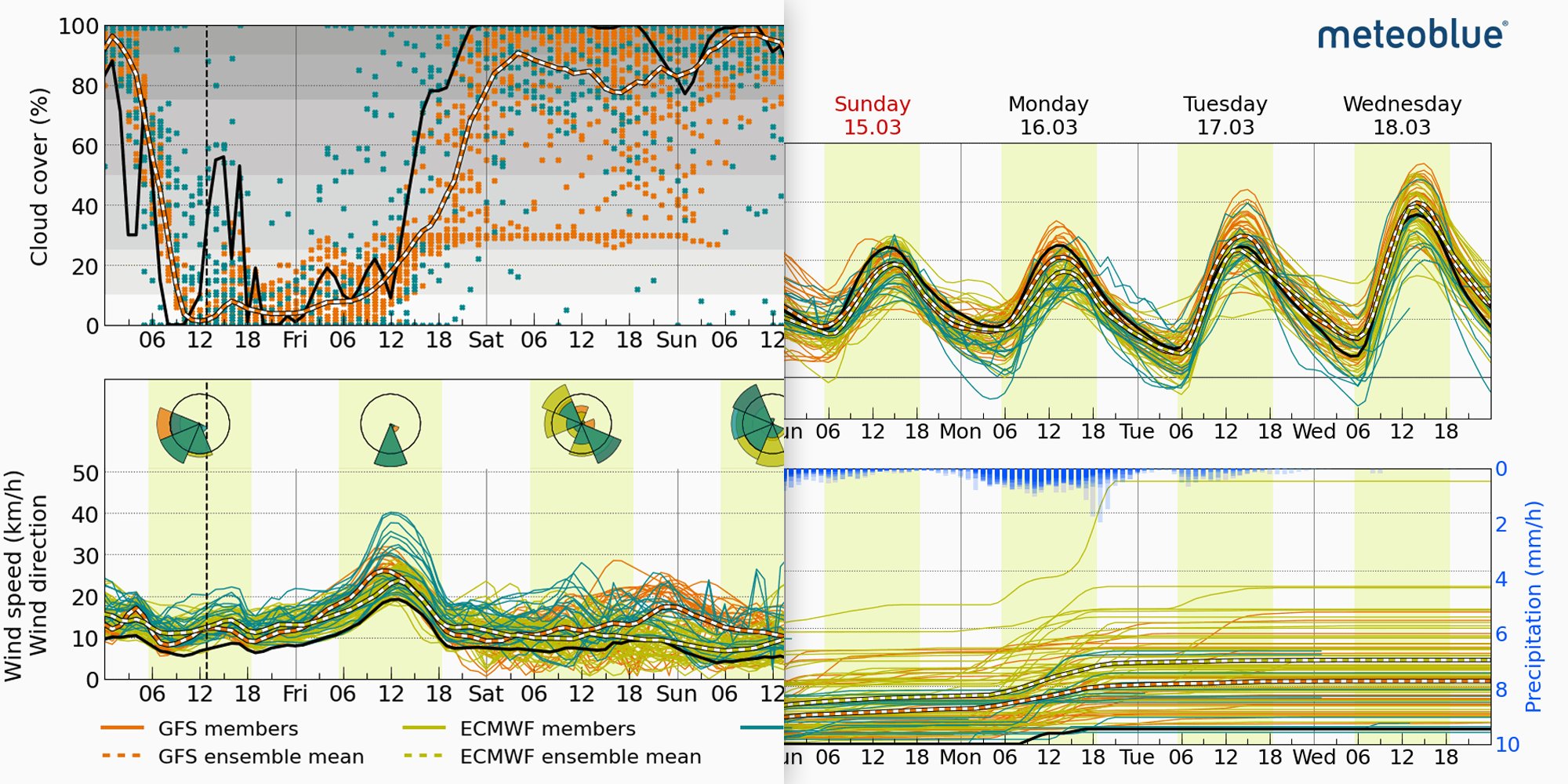
One of the most important developments in modern weather forecasting is ensemble prediction. Instead of running a single forecast simulation, meteorological centres run the same model multiple times with slightly different initial conditions or model configurations. The reason for this approach lies in the chaotic nature of the atmosphere. Even very small uncertainties in the initial atmospheric state can grow over time and eventually produce very different forecast outcomes. A single model simulation therefore represents only one possible scenario.
Ensemble forecasting addresses this limitation by generating a collection of simulations, each representing a plausible evolution of the atmosphere. Together, these simulations form an ensemble of forecasts. By analysing how the individual simulations differ from one another, meteorologists can estimate the range of possible weather outcomes.
If all ensemble members produce very similar results, confidence in the forecast is relatively high. If the simulations diverge significantly, the atmosphere is considered less predictable and a wider range of weather scenarios becomes possible.
Probabilistic Forecasting
Closely related to ensemble forecasting is the concept of probabilistic forecasting. Rather than predicting a single value, probabilistic forecasts express the likelihood of different weather outcomes. For example, instead of stating that a location will receive exactly five millimetres of rainfall, a probabilistic forecast may indicate a seventy percent probability of measurable precipitation or a twenty percent probability that rainfall will exceed ten millimetres.
These probabilities are typically derived from ensemble simulations. If many ensemble members predict rain at a specific location and time, the probability of precipitation increases accordingly.
Probabilistic forecasts are particularly valuable for decision-making. Sectors such as aviation, agriculture, disaster management and energy production often need to evaluate risk rather than rely on a single deterministic forecast value. Explicitly communicating uncertainty allows probabilistic forecasting to better represent the natural variability of the atmosphere.
Machine Learning in Weather Prediction
In recent years, machine learning has begun to play an increasingly important role in meteorology. While traditional numerical weather prediction models are based on the physical equations that govern atmospheric motion, machine learning methods rely on identifying patterns within large datasets.
Using extensive archives of historical weather observations and model outputs, machine learning algorithms can learn relationships between atmospheric variables and forecast outcomes. These techniques are particularly useful for post-processing model forecasts, correcting systematic biases, improving short-term predictions and enhancing local forecast detail. For example, machine learning models can refine temperature forecasts in complex urban environments, improve precipitation estimates or identify atmospheric patterns associated with severe weather events.
Several new artificial intelligence forecasting systems have gained significant attention in recent years. Examples include GraphCast developed by Google DeepMind, Pangu-Weather developed by Huawei and FourCastNet developed by NVIDIA. These models are capable of producing global forecasts within minutes using graphical processing units and significantly less computational power than traditional numerical weather prediction systems.
Despite these advances, such systems still depend heavily on data generated by physics-based models and large reanalysis datasets such as ERA5. For this reason, machine learning is currently best understood as a complementary technology rather than a replacement for traditional numerical weather prediction.
meteoblue Learning MultiModel (mLM)
One example of how machine learning enhances operational forecasting is the meteoblue Learning MultiModel (mLM). This technique improves numerical weather prediction by combining model outputs with real-time weather observations and selecting the model that currently performs best for a given location and situation.
The mLM is currently implemented for air temperature, dew point temperature and wind speed. Before its operational launch in August 2018, it was validated using observations from more than 30,000 meteorological stations worldwide. Verification showed a mean accuracy of about 1.2 K for the 24-hour temperature forecast and 2.0 K for the six-day forecast, outperforming traditional models, MOS simulations and the ERA5 reanalysis.
Through the integration of multiple forecast models, real-time observations and machine learning techniques, the meteoblue Learning MultiModel enhances the practical accuracy of weather forecasts, particularly at local scales.
Hybrid Modelling Systems
The integration of physical modelling and artificial intelligence has given rise to hybrid forecasting systems. These systems combine the strengths of numerical weather prediction with the pattern-recognition capabilities of machine learning. In hybrid approaches, numerical models continue to simulate the fundamental physics of the atmosphere, while machine learning algorithms assist with tasks such as improving initial conditions, accelerating certain computational steps, refining local forecasts or analysing large volumes of ensemble output.
Research at several forecasting centres has demonstrated promising results from combining traditional forecasting systems with machine learning tools. Such hybrid systems illustrate how data-driven methods can enhance weather prediction without replacing the physical foundations of atmospheric modelling. As computing power continues to increase and observational datasets expand, hybrid modelling approaches are expected to play an increasingly important role in the future development of weather forecasting systems.
Looking Ahead
Weather prediction has evolved from manual calculations to global supercomputing systems capable of simulating the atmosphere with remarkable precision. Yet the field continues to advance rapidly. Improvements in satellite observations, data assimilation techniques, ensemble forecasting and artificial intelligence are steadily pushing the boundaries of what is possible.
While uncertainty will always remain an inherent feature of atmospheric prediction, the ability to quantify and communicate that uncertainty has become one of the greatest strengths of modern forecasting.
Together, global and regional models, ensemble systems and emerging hybrid technologies form the foundation of the next generation of weather prediction, a field in which scientific innovation and technological progress remain closely intertwined.
If you want to explore this topic further, visit the meteoblue Community Forum to continue the discussion with experts and community members.