Sun elevation

/ 0.7°
sun-icon
UV 12
05:36
17:42
Waning crescent (328°)
03:39
15:32
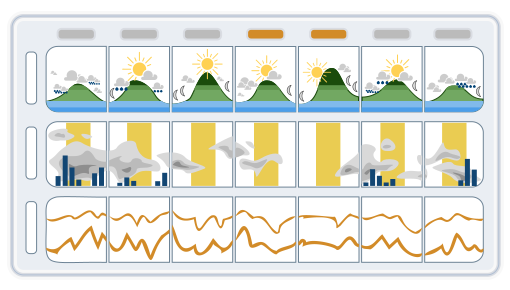
Mostly cloudy and cirrus
Partly cloudy and cirrus
Partly cloudy and few cirrus
Overcast
Partly cloudy
°F
96°
92°
90°
89°
87°
86°
85°
84°
82°
°F
92°
90°
89°
87°
87°
87°
86°
85°
84°
SE
SE
SSE
SSW
SSW
WSW
WSW
WNW
SW
mph
6-14
6-11
5-11
5-11
3-9
2-9
1-8
2-12
2-9
in
0
0
0
0
0
0
0
0
0
%
0
0
0
0
0
0
0
0
0
Mostly cloudy and cirrus
Partly cloudy and cirrus
Partly cloudy and few cirrus
Overcast
Partly cloudy
96°
92°
90°
89°
87°
86°
85°
84°
82°
92°
90°
89°
87°
87°
87°
86°
85°
84°
SE
6-14
SE
6-11
SSE
5-11
SSW
5-11
SSW
3-9
WSW
2-9
WSW
1-8
WNW
2-12
SW
2-9
μg/m³

Dust Levels Very High

Current concentration: 175.67 μg/m³.

Dust Levels Very High

Current concentration: 166.33 μg/m³.

Dust Levels High

Current concentration: 157 μg/m³.

Dust Levels Very High

Current concentration: 166 μg/m³.

Dust Levels Very High

Current concentration: 175 μg/m³.

Dust Levels Very High

Current concentration: 184 μg/m³.

Dust Levels Very High

Current concentration: 179 μg/m³.

Dust Levels Very High

Current concentration: 174 μg/m³.

Dust Levels Very High

Current concentration: 169 μg/m³.
-
0%
-
0%
-
0%
-
0%
-
0%
-
0%
-
0%
-
0%
-
0%

Sun elevation

/ 0.7°
sun-icon
UV 12
05:36
17:42
Waning crescent (328°)
03:39
15:32

Weather radar, Chad

Drizzle
Light
Moderate
Heavy
Very Heavy
Hail

The location marker is placed on Hadjer Timbidja. Orange crosses indicate lightning. Data provided by nowcast.de (available in USA, Europe, Australia). Drizzle or light snow fall might be invisible for the radar. Precipitation intensity is colour coded, ranging from turquoise to red.

Live satellite map, Chad

The location marker is placed on Hadjer Timbidja. [More]

The real-time satellite image combines visible light during daytime with infrared radiation during nighttime. At night, the image is not dark as infrared radiation can detect temperature differences. Unfortunately, low clouds and fog are difficult to distinguish from ground temperatures and thus can be almost invisible during the night. Meteosat satellite images for Europe are updated in real-time every 5 minutes. GOES-16/GOES-17 (North & South America) and Himawari (Asia) images update every 10 minutes.

Precipitation is estimated from radar and satellites. Precipitation estimates from satellites are less accurate at night than during daytime.

© 2026 meteoblue, NOAA Satellites GOES-16 and EUMETSAT. Lightning data provided by nowcast.

Back to top
×
Hey there,
seems like you are using an ad blocker.

Advertising is essential to maintain our free website with unique detail and accuracy.

Please whitelist www.meteoblue.com on your ad blocker or consider buying one of our products:

Already have a subscription?
Then please login.