

Webinar: Managing Weather Risk Across Energy Assets
Weather is hitting energy infrastructure harder, faster and at a greater cost than ever, and a live webinar on 17 June will show operators how to stay one step ahead of it!
The level of detail available in weather forecasts has increased dramatically in recent years. What once focused on broad regional patterns is increasingly moving towards local, street-scale prediction. Modern forecasts can now identify which urban areas will retain heat overnight, where cold air may accumulate, or which locations face the highest risk of intense rainfall and flooding.
|
|
|
|
|
|
|
|
||
|
Icon
|
|
|
|
|
|
|
|
|
|
°F
|
60°
|
59°
|
65°
|
72°
|
72°
|
67°
|
63°
|
60°
|
|
°F
|
55°
|
55°
|
62°
|
68°
|
70°
|
66°
|
61°
|
59°
|
|
|
NE |
NE |
NE |
NNE |
ESE |
SSE |
ESE |
E |
|
mph
|
9-17
|
9-15
|
11-20
|
9-20
|
6-16
|
5-8
|
5-10
|
6-10
|
|
in
|
-
|
-
|
-
|
-
|
< 0.04
|
-
|
0.05
|
-
|
|
%
|
15%
|
15%
|
20%
|
20%
|
25%
|
25%
|
25%
|
25%
|
|
in
|
||||||||
|
12.4 mi
|
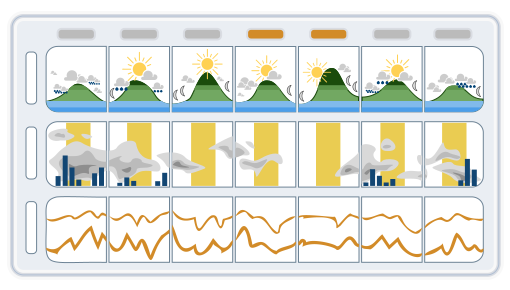
Overnight into Wednesday it is mostly cloudy, but most clouds give way in the morning. Wednesday afternoon it will be cloudy and rainy. The sun will not be visible. There is only a low chance of Precipitation (around 30%). Temperatures as high as 72 °F are foreseen. On Wednesday a gentle breeze is expected (8 to 12 mph). From time to time gusts could reach up to 21 mph. Winds blowing at night and in the morning from Northeast and during the afternoon from North. The weather forecast for St George for Wednesday is likely to be accurate.
Pressure: 1026 hPa
Timezone: AEST (UTC +10:00h)
The location marker is placed on St George. This animation shows the precipitation radar for the selected time range, as well as a 2h forecast. Orange crosses indicate lightning. Data provided by nowcast.de (available in USA, Europe, Australia). Drizzle or light snow fall might be invisible for the radar. Precipitation intensity is colour coded, ranging from turquoise to red.
You can embed this meteogram into your own website. Customize it here.
The real-time satellite image combines visible light during daytime with infrared radiation during nighttime. At night, the image is not dark as infrared radiation can detect temperature differences. Unfortunately, low clouds and fog are difficult to distinguish from ground temperatures and thus can be almost invisible during the night. Meteosat satellite images for Europe are updated in real-time every 5 minutes. GOES-16/GOES-17 (North & South America) and Himawari (Asia) images update every 10 minutes.
Precipitation is estimated from radar and satellites. Precipitation estimates from satellites are less accurate at night than during daytime.
© 2026 meteoblue, NOAA Satellites GOES-16 and EUMETSAT. Lightning data provided by nowcast.
Weather is hitting energy infrastructure harder, faster and at a greater cost than ever, and a live webinar on 17 June will show operators how to stay one step ahead of it!
The level of detail available in weather forecasts has increased dramatically in recent years. What once focused on broad regional patterns is increasingly moving towards local, street-scale prediction. Modern forecasts can now identify which urban areas will retain heat overnight, where cold air may accumulate, or which locations face the highest risk of intense rainfall and flooding.
Advertising is essential to maintain our free website with unique detail and accuracy.
Please whitelist www.meteoblue.com on your ad blocker or consider buying one of our products:
Already have a subscription?
Then please login.